
At our last AI Happy Hour, Tyler, one of our Implementation Specialists, asked the room four questions.
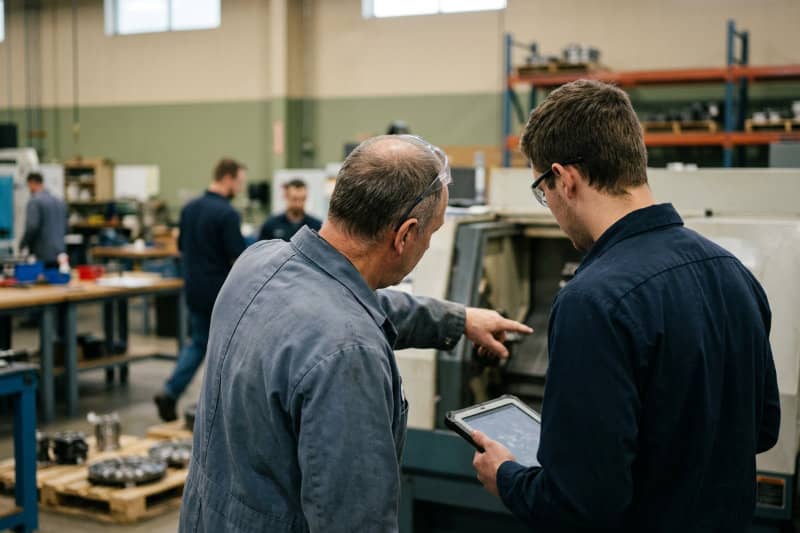
First: how many of you have important knowledge that lives mostly in one person’s head? Maybe it is the person who has been there for thirty years. They know how a particular customer likes things done, how to quote an unusual job, or what to check when a machine starts behaving a certain way.
Every hand went up. Then he asked how many of those people are likely to retire in the next five to ten years.
Same hands.
Next: how many of you are using AI? Almost every hand went up again. ChatGPT, Claude, Copilot, Gemini. Most of the room was already using one of them for work.
Then he asked one final question:
How many of you are using AI that is actually built around the way your business operates?
One hand went up.
That was the most interesting part of the evening for me. Manufacturers are not sitting on the sidelines waiting to see whether AI matters. Most of the people we speak to are already using it.
The gap is somewhere else. They are using AI that knows a lot about the world, but very little about their company.
Personal AI and institutional AI
We’ve started using a simple distinction that I think is helpful. Most AI being used at work today is personal AI.
You open ChatGPT or Copilot, ask it to write an email, summarize something, analyze a spreadsheet or help think through a problem. It can be incredibly useful.
But unless you give it the right context, it does not automatically know your customer requirements, your inventory, your quoting rules, your part numbers, your workarounds or the exceptions your team has learned over the last twenty years. That is why the answer can be perfectly reasonable and still not be the answer someone inside your company would give.
Institutional AI is different. The idea is to give AI access to the specific information it needs to work inside your business: your processes, your terminology, your business rules and, where appropriate, current data from the systems you already use.
If someone asks about an order, the useful answer may depend on the order itself, the customer’s history, a company policy and an exception that only experienced employees currently know. General AI does not come with that context.
Your business has to provide it. That is a much bigger shift than simply giving everyone a ChatGPT account.
Personal AI can make an individual employee more productive. Institutional AI is about making the knowledge of the company more usable.
Where the problem gets expensive
Before Tyler joined us, he was director of technology for a plumbing and HVAC distributor with around a hundred employees. There was a particular quoting process that only two people really knew how to do.
A quote could take 30 to 45 minutes once someone started working on it. But because everything had to go through those two people, the actual wait could stretch into days.
That is not an unusual technology problem. It is a knowledge problem.
The business has developed a way of doing something important, but that knowledge is concentrated in a couple of people rather than available to the rest of the organization. You see the same thing with purchasing decisions, production planning, customer exceptions, troubleshooting, pricing and dozens of other processes.
The first question I would ask in a situation like that is not, “Which AI model should we use?” It is: “What do those two people know that everybody else doesn’t?”
Get that out of people’s heads first. Then you have something useful to work with.
One of the best questions we heard that night
When Tyler started talking about AI and company data, someone in the room challenged him on security. His question was basically: secure from who?
I thought that was exactly the right question. “Is AI secure?” is too broad to be useful.
You need to know what information the AI can access. Where that information is being sent. Which model or provider is involved. What that provider is allowed to do with the data. Who inside your company can access it. What the AI is allowed to do in your systems.
The answers can be very different depending on how the AI is deployed. That is also why I would be careful about putting proprietary company information into consumer AI tools without first understanding the settings, terms and policies involved.
For operational AI, permissions matter just as much as intelligence. An employee in accounts receivable probably does not need access to engineering data. An AI assistant doing accounts receivable work should not have access to it either.
For some organizations, especially those with stricter regulatory or contractual requirements, the deployment requirements may be tighter still.
There is no single checkbox called “secure AI.” There are a series of decisions about data, access, models and infrastructure that need to match the risk involved.
The twenty-year-old spreadsheet
Tyler asked another question that night.
How many people have an Excel spreadsheet that is twenty years old and nobody completely understands anymore?
Again, hands everywhere.
Anyone who has spent enough time around manufacturing or distribution has seen one of these. Sometimes that spreadsheet exists because there was a process the ERP did not handle cleanly. Someone built a workaround. Then the business changed, so the spreadsheet changed. More logic was added. Another workaround appeared.
Eventually the spreadsheet became part of how the company operates. Then the person who built it left.
The interesting thing about these spreadsheets is not that companies should get rid of Excel. It is what the spreadsheet represents.
There is business logic in there. There are assumptions, decisions, exceptions and pieces of operational knowledge that the company depends on.
Your ERP is very good at recording transactions. It can tell you what was ordered, received, produced, invoiced or paid.
What it often does not contain is all the reasoning around those transactions.
Why do we handle this customer differently? Why is this item reordered at that level? Why does this job go through a different process? Why do we ignore the standard rule in this particular situation?
That information usually lives somewhere else. Sometimes it is in a spreadsheet. Sometimes it is in an SOP. Very often it is in someone’s head.
That is the part of the AI conversation I think manufacturers should be paying much more attention to.
Two places I would start
You do not need an enterprise AI strategy before you can start learning where this could be useful. I would start with two things.
Capture the conversations where operational knowledge is already being exchanged.
With the appropriate consent and company policies in place, record process walkthroughs, internal meetings and conversations where experienced people explain how work actually gets done. Then review the transcripts.
You will start finding repeated questions, undocumented exceptions and processes that depend far more heavily on particular individuals than anyone realized.
Take a report you already use and interrogate it differently.
Sales history. Production. Inventory. AR aging. Open orders.
You probably already run these reports and scan them for the things you know to look for. AI can help you explore the same information from different angles and surface patterns worth investigating.
Neither exercise requires a huge AI project. But both will teach you something important:
where the valuable knowledge in your company actually lives, and what an AI system would need to know before you trusted it with real operational work.
That, to me, is the more useful AI readiness question. Not: “Are you using AI?”
Most companies are.
The better question is:
What does your AI actually know about the way your company works?

Corey Luckow
Corey joined Zumasys in 2008 and has led major changes in its software and technology strategy. He provides executive oversight for CompanyOS and helps customers establish priorities for work that moves from discovery into implementation.